
链霉亲和素磁珠的组成和反应原理
2026.01.22
链霉亲和素磁珠(Streptavidin Magnetic Beads)是一类以链霉亲和素(Streptavidin)为功能配基、表面共价偶联在超顺磁性微球上的亲和介质,依托SA-生物素的超高亲和力,实现目标分子的快速、高特异性富集与磁分离,广泛用于生物素化分子(DNA、RNA、抗体、蛋白等)的高选择性捕获与富集。
Streptavidin magnetic beads are a type of affinity medium that uses streptavidin as the functional ligand and is covalently coupled to superparamagnetic microspheres on the surface. Relying on the extremely high affinity of SA-biotin, they enable rapid and highly specific enrichment and magnetic separation of target molecules, and are widely used for the high-selective capture and enrichment of biotinylated molecules (such as DNA, RNA, antibodies, proteins, etc.).
链霉亲和素磁珠的核心原理是利用链霉亲和素与生物素之间极强的非共价结合能力。链霉亲和素是一种从链霉菌中提取的四聚体蛋白,每个亚基都能与一个生物素分子结合。通过将链霉亲和素共价偶联到磁性纳米颗粒表面,形成功能化磁珠。这种技术结合了磁珠的快速分离特性和链霉亲和素-生物素系统的高亲和力(Kd≈10⁻¹⁵ M),实现了对生物分子的高效、特异性捕获和纯化。
The core principle of streptavidin magnetic
beads is is based on the extremely strong non-covalent binding ability between
streptavidin and biotin. Streptavidin is a tetrameric protein extracted from
Streptomyces bacteria, with each subunit capable of binding to a biotin
molecule. Functionalized magnetic beads are formed by covalently coupling
streptavidin to the surface of magnetic nanoparticles. This technology combines
the rapid separation properties of magnetic beads with the high affinity of the
streptavidin-biotin system (Kd≈10⁻¹⁵ M) to achieve efficient and specific capture
and purification of bio molecules.
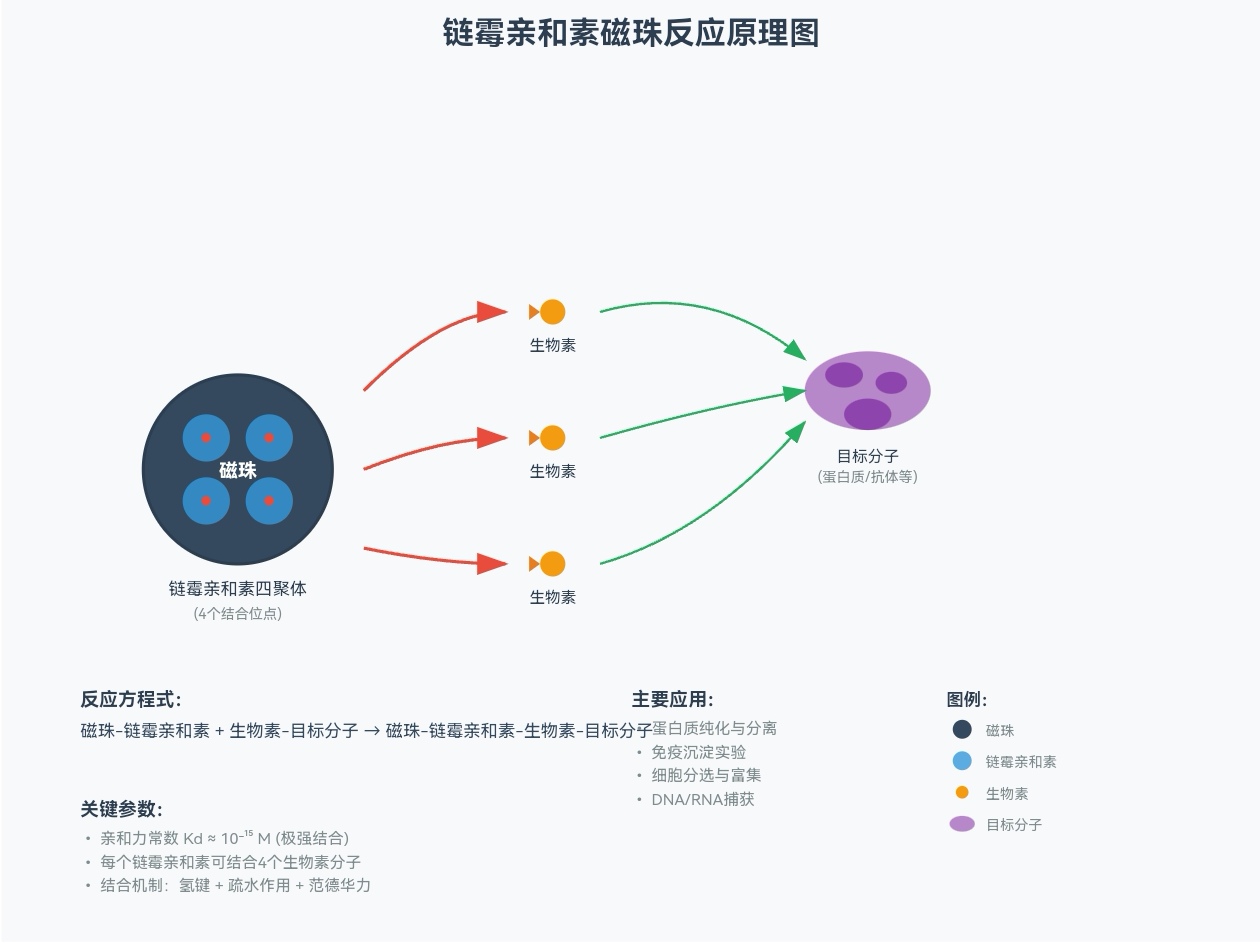
一、链霉亲和素磁珠主要由以下几部分组成:
1. 磁性核心:这是磁珠的核心部分,通常由铁、钴、镍等磁性金属或其合金制成。这些材料能够被外部磁场吸引,从而实现磁珠的快速分离和回收。
This is the core part of the magnetic beads, usually made of magnetic metals such as iron, cobalt, nickel or their alloys. These materials can be attracted by external magnetic fields, allowing for rapid separation and recovery of magnetic beads.
2. 链霉亲和素:链霉亲和素是一种蛋白质,能够与生物素(biotin)高度特异性结合。生物素是一种小分子化合物,能够与链霉亲和素的四个结合位点紧密结合,形成高度稳定的复合物。Streptavidin is a protein that highly specifically binds to biotin. Biotin is a small molecule compound that can bind tightly to the four binding sites of streptavidin to form a highly stable complex.
3. 表面修饰材料:为了提高磁珠的稳定性和功能性,通常需要对磁珠表面进行修饰。常用的表面修饰材料包括聚乙二醇(PEG)、聚丙烯酸酯(PAA)等。这些材料不仅可以增加磁珠的亲水性,还可以减少非特异性吸附,提高检测的灵敏度和特异性。
In order to improve the stability and functionality of magnetic beads, it is usually necessary to modify the surface of the magnetic beads. Commonly used surface modification materials include polyethylene glycol (PEG), polyacrylate (PAA), etc. These materials can not only increase the hydrophilicity of the magnetic beads, but also reduce non-specific adsorption and improve the sensitivity and specificity of detection.
二、链霉亲和素磁珠核心材料和表面修饰材料的选择依据
1.磁性核心材料 磁性核心材料的选择主要考虑以下几个因素:
a.磁性能:材料的磁性能(如磁化强度和矫顽力)直接影响磁珠的磁响应性和分离效率。高磁性能的材料能够产生更强的磁场,从而提高分离速度和效率。
The magnetic properties of materials (such as magnetization and coercivity) directly affect the magnetic responsiveness and separation efficiency of magnetic beads. Materials with high magnetic properties can generate stronger magnetic fields, thereby increasing separation speed and efficiency.
b.生物相容性:磁性材料必须具有良好的生物相容性,以避免对生物样本的污染和毒性。铁、钴、镍及其合金是常用的生物相容性材料。
Magnetic materials must have good biocompatibility to avoid contamination and toxicity to biological samples. Iron, cobalt, nickel and their alloys are commonly used biocompatible materials.
c.稳定性:磁性材料需要在各种环境条件下保持稳定性,包括高温、高压和酸碱环境。因此,选择具有高稳定性的材料非常重要。
Magnetic materials need to remain stable under a variety of environmental conditions, including high temperatures, high pressures, and acid-base environments. Therefore, it is important to choose materials with high stability.
2.表面修饰材料 表面修饰材料的选择主要考虑以下几个因素:
a.亲水性:修饰材料需要提高磁珠的亲水性,使其在水溶液中具有良好的分散性和稳定性。聚乙二醇(PEG)是一种常用的亲水性修饰材料。
The modified material needs to improve the hydrophilicity of the magnetic beads so that they have good dispersion and stability in aqueous solutions. Polyethylene glycol (PEG) is a commonly used hydrophilic modification material.
b.减少非特异性吸附:修饰材料应能减少磁珠表面的非特异性吸附,从而提高检测的特异性和灵敏度。聚丙烯酸酯(PAA)等材料能够有效减少非特异性吸附。
Modified materials should be able to reduce non-specific adsorption on the surface of magnetic beads, thereby improving the specificity and sensitivity of detection. Materials such as polyacrylate (PAA) can effectively reduce non-specific adsorption.
c.稳定性:修饰材料需要在各种环境条件下保持稳定,不会因pH变化、温度变化或机械力而脱落。
Modified materials need to remain stable under various environmental conditions and not fall off due to pH changes, temperature changes or mechanical forces.
三.微观结构及其对性能的影响 链霉亲和素磁珠的微观结构对其性能有重要影响。
1.磁珠的微观结构包括以下几个部分:
a.磁核:这是磁珠的核心部分,通常为球形或类球形。磁核的尺寸和形状直接影响磁珠的磁响应性和分离效率。
This is the core part of the magnetic beads, usually spherical or spherical-like. The size and shape of the magnetic core directly affect the magnetic responsiveness and separation efficiency of the magnetic beads.
b.亲水性外壳:这是修饰材料形成的外壳,覆盖在磁核表面。亲水性外壳不仅增加了磁珠的亲水性,还减少了非特异性吸附。
This is a shell formed by modified materials covering the surface of the magnetic core. The hydrophilic shell not only increases the hydrophilicity of the magnetic beads, but also reduces non-specific adsorption.
c.链霉亲和素层:这是位于磁珠表面的链霉亲和素层,负责与生物素结合。链霉亲和素层的存在使得磁珠能够特异性地捕获目标分子。
This is the layer of streptavidin located on the surface of the magnetic beads, which is responsible for binding to biotin. The presence of the streptavidin layer enables the magnetic beads to specifically capture target molecules.
2.微观结构对性能的影响
a.磁响应性:磁核的尺寸和形状直接影响磁珠的磁响应性。通常,较大的磁核能够产生更强的磁场,从而提高分离速度和效率。
The size and shape of the magnetic core directly affect the magnetic responsiveness of the magnetic beads. Generally, larger magnetic cores produce stronger magnetic fields, which increases separation speed and efficiency.
b.亲水性和非特异性吸附:亲水性外壳的存在显著提高了磁珠的亲水性,减少了非特异性吸附,提高了检测的特异性和灵敏度。
The presence of the hydrophilic shell significantly improves the hydrophilicity of the magnetic beads, reduces non-specific adsorption, and improves the specificity and sensitivity of detection.
c.结合容量和稳定性:链霉亲和素层的存在使得磁珠能够高容量地结合目标分子。同时,链霉亲和素与生物素的特异性结合具有极高的稳定性,确保了检测的可靠性。
The presence of the streptavidin layer enables the magnetic beads to bind target molecules with high capacity. At the same time, the specific binding of streptavidin and biotin has extremely high stability, ensuring the reliability of detection.